Wall-mounted indoor unit
A simple and acceptable scenario for a separate room or several zones if the location, airflow direction, noise, refrigerant line route, drainage, and outdoor unit are selected correctly.

How to choose apartment air conditioning before finishing works: wall-mounted, ducted, and multi-split solutions, lines, drainage, facade, noise, service, and design.
Guide
This page explains how to choose the apartment air conditioning format without ad hoc decisions: a wall-mounted indoor unit, a ducted solution, multi-split, lines, drainage, noise, and service.
Renovation
Ventall does not work in the format of “hanging one air conditioner in a finished room”. The company becomes involved where there is an engineering task: several rooms, hidden or well-planned refrigerant lines, facade restrictions, drainage, noise, service, and a design solution.
Even if wall-mounted indoor units are physically installed later, their locations, refrigerant lines, drainage, power supply, and impact on the interior must be planned before finishing works.
For ducted air conditioning, this is even more important: space above the ceiling, air ducts, grilles or diffusers, access panels, drainage, and service access are required.
Selection
First, cooling zones, the number of rooms, heat gains from sun and equipment, ceiling height, the possibility of placing the outdoor unit, the route of refrigerant lines, drainage, and service access are defined.
Only after that does it make sense to choose the system format and equipment. The same air conditioner cannot be equally suitable for every apartment, even if the room areas are similar.
Types
A simple and acceptable scenario for a separate room or several zones if the location, airflow direction, noise, refrigerant line route, drainage, and outdoor unit are selected correctly.
A hidden and comfortable solution with air supplied through grilles or diffusers. It requires space above the ceiling, air ducts, access panels, drainage, and noise calculation.
Several indoor units connected to one outdoor unit. It helps reduce the number of units on the facade, but requires checking line lengths, capacity, drainage, and service.
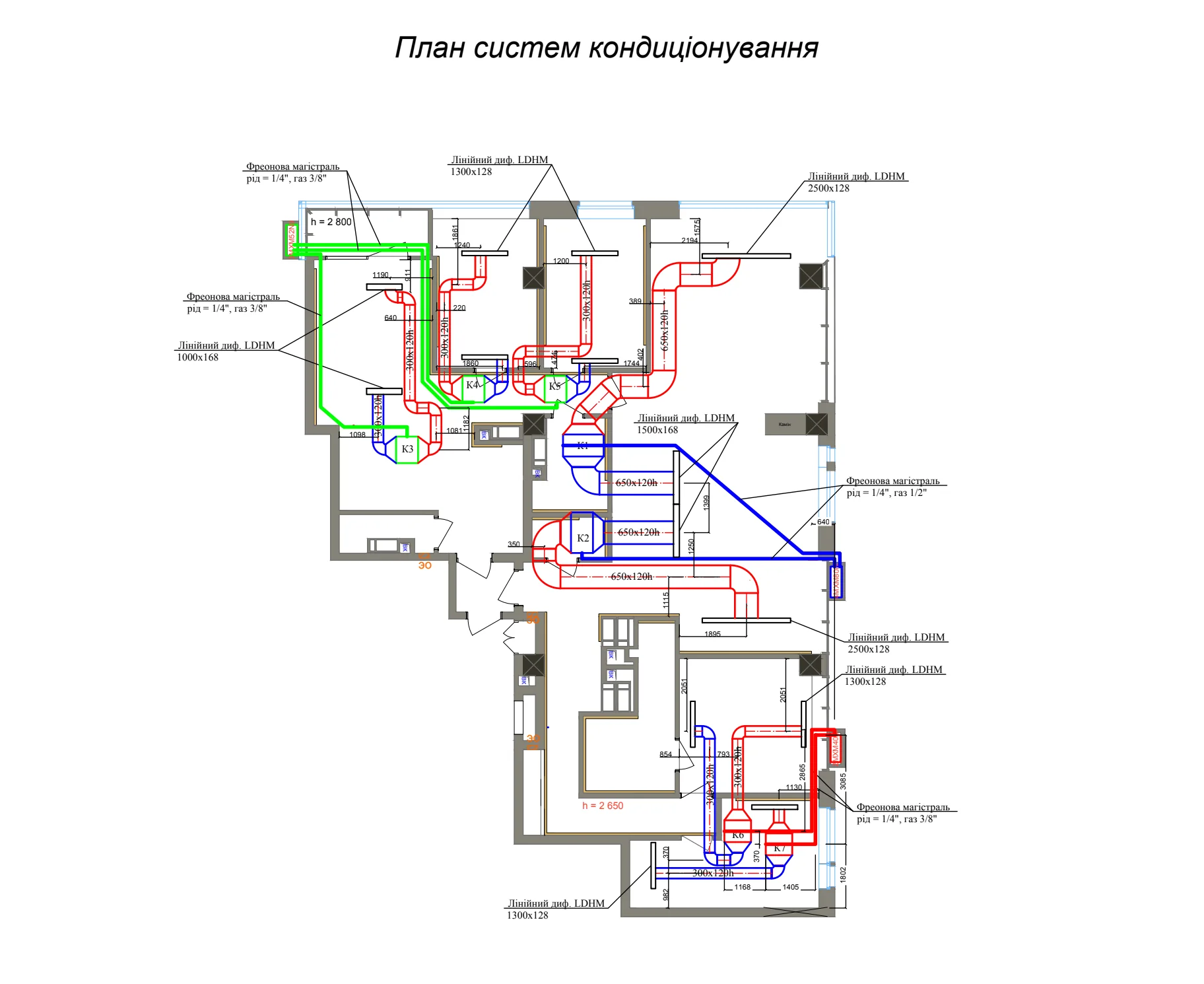
Fragment of an apartment working design: ducted air conditioners, air ducts, refrigerant lines, grilles, and service zones are planned before finishing works.
View project exampleComfort
For an apartment, it is not enough for the system “to cool”. In a bedroom or child’s room, a poorly selected indoor unit may blow onto the bed, be noisy at night, or create noticeable airflow where a person stays for a long time.
A ducted solution may be more comfortable for sleep and continuous operation because air is distributed more gently. But it should not be designed without space above the ceiling, correct aerodynamics, drainage, access panels, and service access.
A wall-mounted indoor unit is not a “bad” solution. It is suitable if its location, noise, airflow direction, refrigerant line route, and drainage do not conflict with the layout and interior.
Installation
Air
Air conditioning is responsible for temperature: cooling, partial heating in the shoulder seasons, and comfort in hot weather. But a standard air conditioner works with indoor air and does not supply fresh outdoor air.
If the apartment needs not only cooling but also fresh air, this is solved by ventilation. That is why ventilation and air conditioning are planned together for a complete microclimate, but their functions are not mixed.
Parameters
For apartment air conditioning, cooling kW are not the only important factor. Heat gains by room, seasonal efficiency, noise level of indoor and outdoor units, correct drainage, refrigerant, service, and real installation limitations must be checked.
Heating in the shoulder seasons can be mentioned as an additional scenario, but not as the main value and not as a universal promise. Operating temperature limits, SEER, SCOP, and noise are checked in the equipment documentation for the specific model or unit combination.
The technical assessment can include DBN V.2.5-67:2013 for air conditioning, EN 16798-1 / ISO 17772-1 for indoor environmental parameters, EN 14511 and EN 14825 for capacity and seasonal efficiency, EN 12102-1 for equipment noise, and Regulation (EU) 2024/573 for refrigerants.
Next
If you are only choosing the apartment air conditioning format, it is worth going to the full Ventall guide. It separately shows system types, indoor units, advantages and limitations of split, multi-split, multi-zone, and ducted solutions.
For this page, the air conditioning section is especially important: it helps show why selection starts not with a brand, but with the apartment, lines, noise, drainage, facade, and usage scenarios.
Related
Leave your contact and we will get back to discuss the right solution for your project.