Hidden ducted solution
Ducted air conditioning, supply and exhaust ventilation, sound attenuators, and linear slot diffusers can be almost invisible in the interior if they are planned before finishing works.

How to plan apartment ventilation and air conditioning before finishing works: fresh air, temperature, hidden lines, noise, facade, drainage, and service.
Guide
This page explains how to plan fresh air and temperature control together in an apartment, and then leads to the full Ventall system selection guide.
Renovation
For apartments, Ventall works at the renovation stage or before finishing works. That is when air ducts, refrigerant lines, drainage, and automation cables can be routed properly and service access can be left.
After renovation is complete, full integration of ventilation and air conditioning almost always becomes a compromise: the ceiling has to be opened, space for lines has to be found, the facade has to be approved, and limitations that could have been avoided have to be accepted.
The approach is the same as in a house: engineering systems should be planned in advance, not added after the interior is already assembled.
Logic
Ventilation is responsible for fresh air, removing stale air, odors, moisture, and excess CO2. Air conditioning is responsible for temperature: cooling, room-by-room operation, comfort in hot weather, and partial heating in the shoulder seasons.
In an apartment, these tasks should not be mixed into one “universal” system. But they should be designed together: ceiling, facade, shafts, drainage, noise, grilles, diffusers, and service access must be coordinated before finishing works begin.
Scenarios
The solution depends on the layout, budget, ceiling height, design requirements, facade restrictions, and how concealed the system should be.
Ducted air conditioning, supply and exhaust ventilation, sound attenuators, and linear slot diffusers can be almost invisible in the interior if they are planned before finishing works.
Some rooms may have ducted indoor units, while others may have wall-mounted air conditioners. This is not inherently “worse”: the solution should match the task, layout, and budget.
Valves, wall ventilators, and local heat recovery units are not Ventall’s main profile. The company works with complete engineered systems, not compromises after renovation.
Selection
Design
For an apartment, it is important not just to choose ventilation and air conditioning separately, but to see how they are routed within one renovation project. The design shows air ducts, ducted indoor units, supply points, exhaust points, sound attenuators, external grilles, and locations where the system must remain accessible for service.
This design documentation helps coordinate the ceiling, lines, drainage, noise, equipment, and design before finishing works. It is not a “nice example”, but practical engineering logic without which hidden systems in an apartment quickly become a compromise.
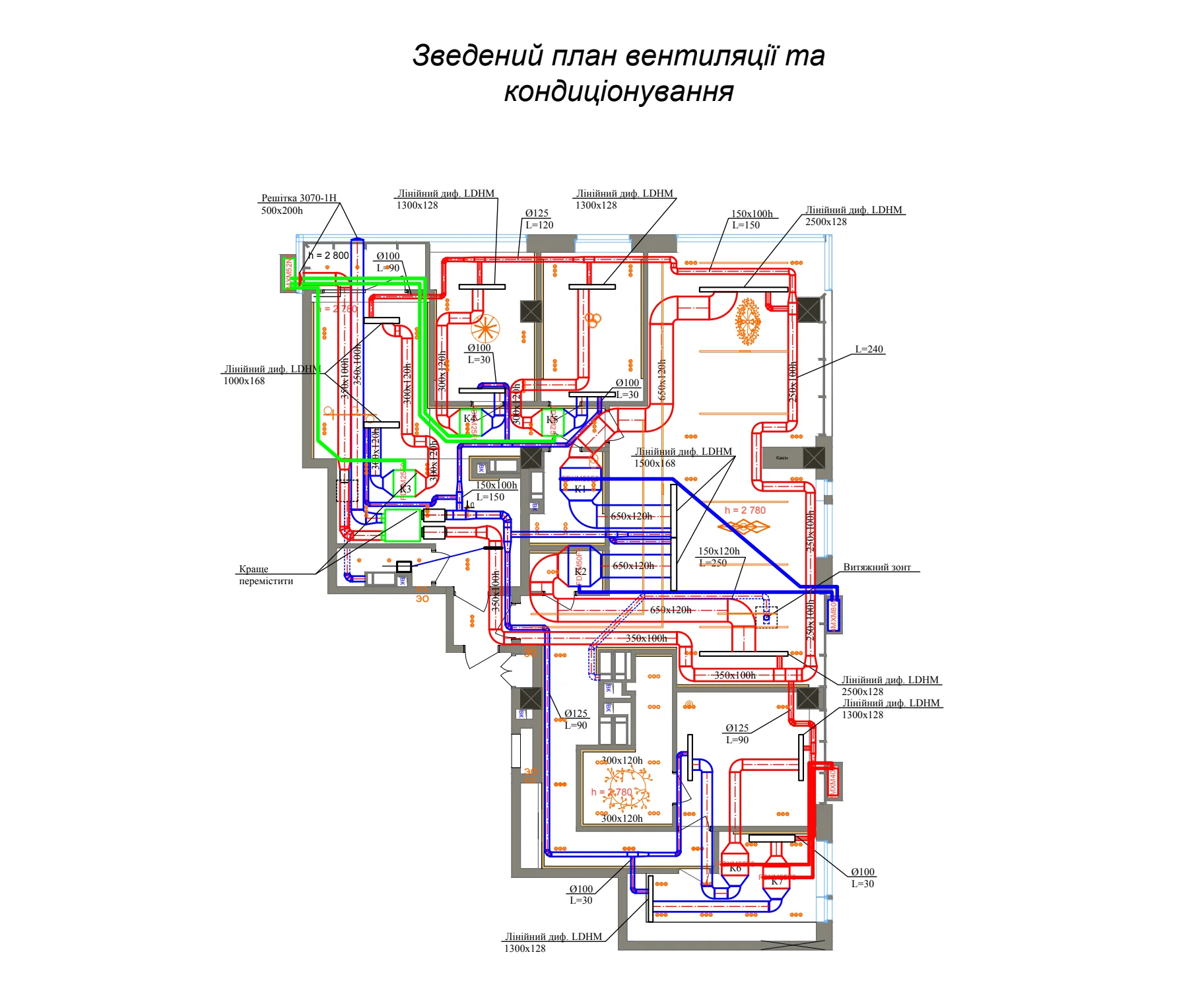
Fragment of an apartment working design: ventilation, air conditioning, air ducts, refrigerant lines, grilles, and service zones are coordinated before finishing works.
View project exampleStandards
In an apartment, it is important not only to hide the system neatly, but also to check its operation: actual airflow rates, balance of supply and exhaust air, noise, drainage, automation, and service access.
For apartment ventilation and air conditioning, it is relevant to consider DBN V.2.2-15:2019 for residential buildings, DBN V.2.5-67:2013 for HVAC systems, EN 16798-1 for indoor environmental parameters, and EN 12599 / DSTU EN 12599:2025 for checking and balancing systems after installation.
Noise in bedrooms and living rooms should be assessed not through a general promise of “quiet”, but through documented dB(A), air velocity, sound attenuators, unit installation location, and actual verification after commissioning.
Next
If you are only choosing an approach to the apartment microclimate, it is worth going to the full Ventall guide. It explains ventilation types, air conditioning types, pros and cons of solutions, estimates, design, installation, and service.
For the apartment scenario, the block about coordinating ventilation and air conditioning is important: it helps explain why fresh air and temperature are different tasks, but they should be planned together before finishing works.
Related
Leave your contact and we will get back to discuss the right solution for your project.