Multi-zone air conditioning systems
Suitable for multi-zone commercial facilities where different operating modes, flexible control, and fewer outdoor units on the facade or roof are required. VRF / VRV systems are part of this group.

How to choose multi-zone air conditioning systems, chillers, fan coil units, and related solutions for offices, retail facilities, warehouses, production spaces, and large buildings.
Cooling for business facilities
The main focus is multi-zone air conditioning systems, including VRF / VRV. At the same time, chillers, fan coil units, and chiller-fan coil systems remain important for larger commercial and industrial facilities.
Task
In an office, store, hotel, warehouse, or production space, the task is not to cool square meters in the abstract. It is to cool specific zones: an open office area, private offices, a sales floor, a server room, conference halls, storage areas, or process spaces.
That is why the solution is evaluated by heat gains, the number of zones, refrigerant or water pipe routes, available locations for outdoor units, noise, automation, service access, and what will happen under peak load.
Scenarios
Different systems solve different tasks. The choice depends not on the equipment name, but on the number of zones, heat gains, routes, noise, automation, service access, and operating mode of the facility.
Suitable for multi-zone commercial facilities where different operating modes, flexible control, and fewer outdoor units on the facade or roof are required. VRF / VRV systems are part of this group.
Appropriate for larger facilities, hotels, conference halls, warehouses, or scenarios where a water-based cooling system and a separate cooling distribution strategy are required.
Required for server rooms, technical rooms, separate warehouse areas, or process zones where stable temperature, redundancy, or a special operating mode is important.
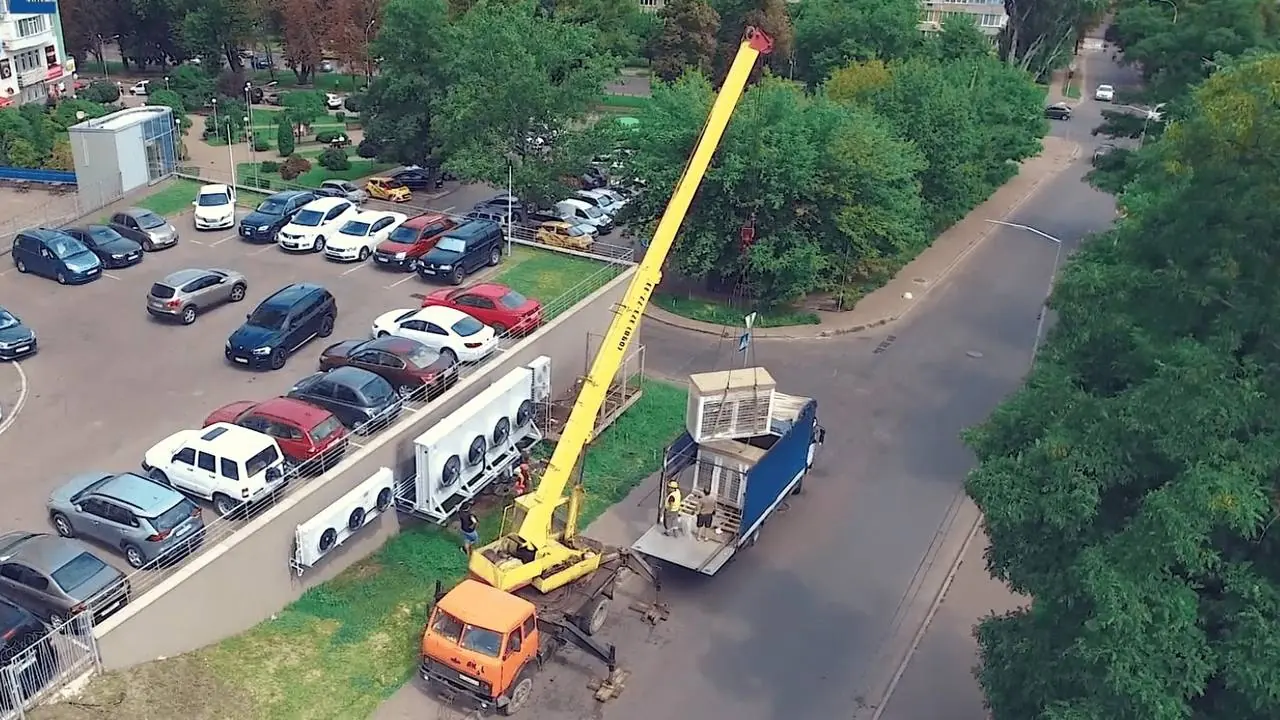
Real Ventall project example: VARUS, Parkove Misto residential complex: 2 Cooper&Hunter modular chillers, 140 kW total.
View VARUS projectChecks
Standards and checks
During design, the general requirements for heating, ventilation, and air conditioning are checked, including DBN V.2.5-67:2013, as well as requirements for the specific building type and cooling system.
Capacity, seasonal efficiency, SEER, SCOP, EER, COP, and operating temperatures must be confirmed by the equipment documentation or technical datasheet for the specific model; EN 14511 and EN 14825 are used for test methods and seasonal efficiency. EN 378 is important for refrigeration system safety, EN 12102-1 for equipment noise, and Regulation (EU) 2024/573 for refrigerants.
A multi-zone air conditioning system should not be presented as the best option for every facility. It is a strong scenario for many business tasks, but not a universal answer: for some facilities, a chiller-fan coil system, a separate precision solution, or another configuration may be more appropriate.
Projects
two Cooper&Hunter modular chillers with a total capacity of 140 kW; calculation, design, installation, commissioning, and crane lifting of the equipment.
View VARUS projectHaier MRV multi-zone system of approximately 70 kW, floor-by-floor ventilation, and separate cooling for a small server room.
View office projectConference hall ventilation at 9,000 m³/h and cooling through a chiller-fan coil system connected to an existing chiller.
View hotel projectNext
If the task has not yet been calculated, the next step is design: heat gains, zones, routes, equipment, automation, and service access.
If the system has already been implemented by Ventall, service must be planned for it: filters, drainage, heat exchangers, refrigerant circuit, automation, and alarm signals.
Related
Leave your contact and we will get back to discuss the right solution for your project.