General exhaust and supply ventilation
Works with the balance of supply and exhaust air, heat, humidity, odors, and the overall air conditions in a production or warehouse area.

How industrial ventilation is planned for production facilities, warehouses, process zones, heat, dust, odors, local exhaust, filtration, and industrial processes.
Industrial HVAC
For industrial facilities, it is important not only to select equipment, but also to prepare air ducts, non-standard assemblies, filtration, automation, service access, and system performance checks.
Task
In a production workshop or process room, air exchange depends on the process: heat, dust, smoke, odors, moisture, aerosols, gases, local sources of emissions, and equipment operating schedule.
That is why one universal system does not suit every workshop. Some tasks require general ventilation, while others need local exhaust, make-up air, filtration, heat removal, or separate automation.
Scenarios
Works with the balance of supply and exhaust air, heat, humidity, odors, and the overall air conditions in a production or warehouse area.
Required near the source: welding, painting, hot processes, dust, odors, or aerosols. Dust extraction can be part of a solution for dust or local emissions, but its parameters must be defined separately for the process and pollution source.
Help not just to “extract” air, but to maintain balance, filter the air stream according to the process, and avoid uncontrolled negative pressure.
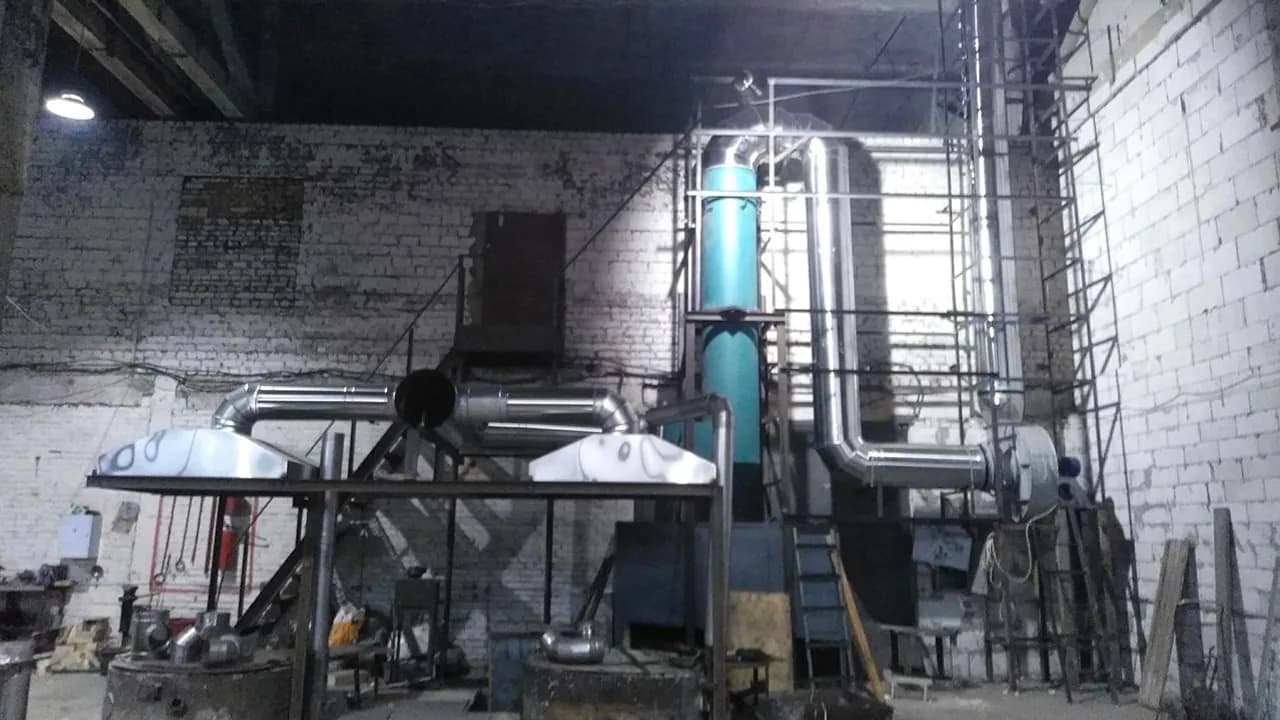
Real Ventall project example: YUGOMET: removal of hot air and gases, water and cyclone filtration.
View YUGOMET projectPreparation
For industrial tasks, the ability to prepare air ducts, non-standard assemblies, component sets, sealed connections, testing, and quality control of finished products is important. This preparation can be viewed on the Ventall production page.
Specific m3/h, kW, and technical parameters must be confirmed by an implemented facility or project documentation, not only by a general description of fabrication preparation.
Projects
Cheese production facility: 3,000 m³/h ventilation, 3 Cooper&Hunter dehumidifiers, and air conditioning up to 30 kW for food production.
View TASbio projectVTS ventilation, water filtration, recirculation, and removal of fine paint particles.
View painting zone projectVENTS supply and exhaust ventilation system at 600 m³/h with automation and reheating as an example of an auxiliary process space.
View canteen projectStandards and checks
Industrial ventilation cannot guarantee “removal of all harmful substances” without calculating emission sources, operating mode, filtration, make-up air, fire safety requirements, and system operation.
During design, the general requirements for heating, ventilation, and air conditioning are checked, including DBN V.2.5-67:2013, as well as specific requirements for the production facility, warehouse, or process zone.
Workplace microclimate, maximum permissible concentrations of harmful substances, dust, aerosols, heat gains, local exhaust hoods, filtration, noise, fire safety, air duct materials, and service access are checked separately.
For welding, painting, hot processes, food production, warehouses with storage requirements, or dust zones, specific sector standards and equipment documentation are required for the actual process.
ATEX or explosive atmospheres should not be presented as a standard solution without a separate regulatory check, input data, and confirmed project examples.
Next
If there is heat, dust, odors, aerosols, local emission sources, or a complex process, an engineering calculation is required. Without it, it is impossible to correctly assess airflows, air duct materials, filtration, noise, fire risks, and service.
After design, installation, commissioning, balancing, and service are important because an industrial system must work in real operating modes, not only look correct in drawings.
Related
Leave your contact and we will get back to discuss the right solution for your project.