Wall-mounted split systems
A simpler and cheaper solution for separate rooms. Suitable if the unit does not interfere with the interior, the airflow does not blow onto people, and the facade allows outdoor units to be placed.

Design-based air conditioning for a private house: wall-mounted, ducted, and multi-split solutions, refrigerant lines, drainage, facade, noise, comfort, and service.
Guide
This material explains how to choose air conditioning for a private house: wall-mounted or ducted indoor units, multi-split, combined schemes, facade, refrigerant lines, drainage, quiet operation, and comfort in bedrooms.
When
This page is mainly for homeowners at the construction or renovation stage. This is the moment when lines, drainage, power supply, and locations for indoor and outdoor units can still be planned correctly.
For ducted air conditioning, air ducts, technical components, access panels, and service access are also required. Grilles and final elements can be installed after finishing, but the engineering base has to be planned earlier.
Wall-mounted indoor units should also not be added later “somehow”. Their locations, lines, drainage, and impact on the interior are better defined before finishing works.
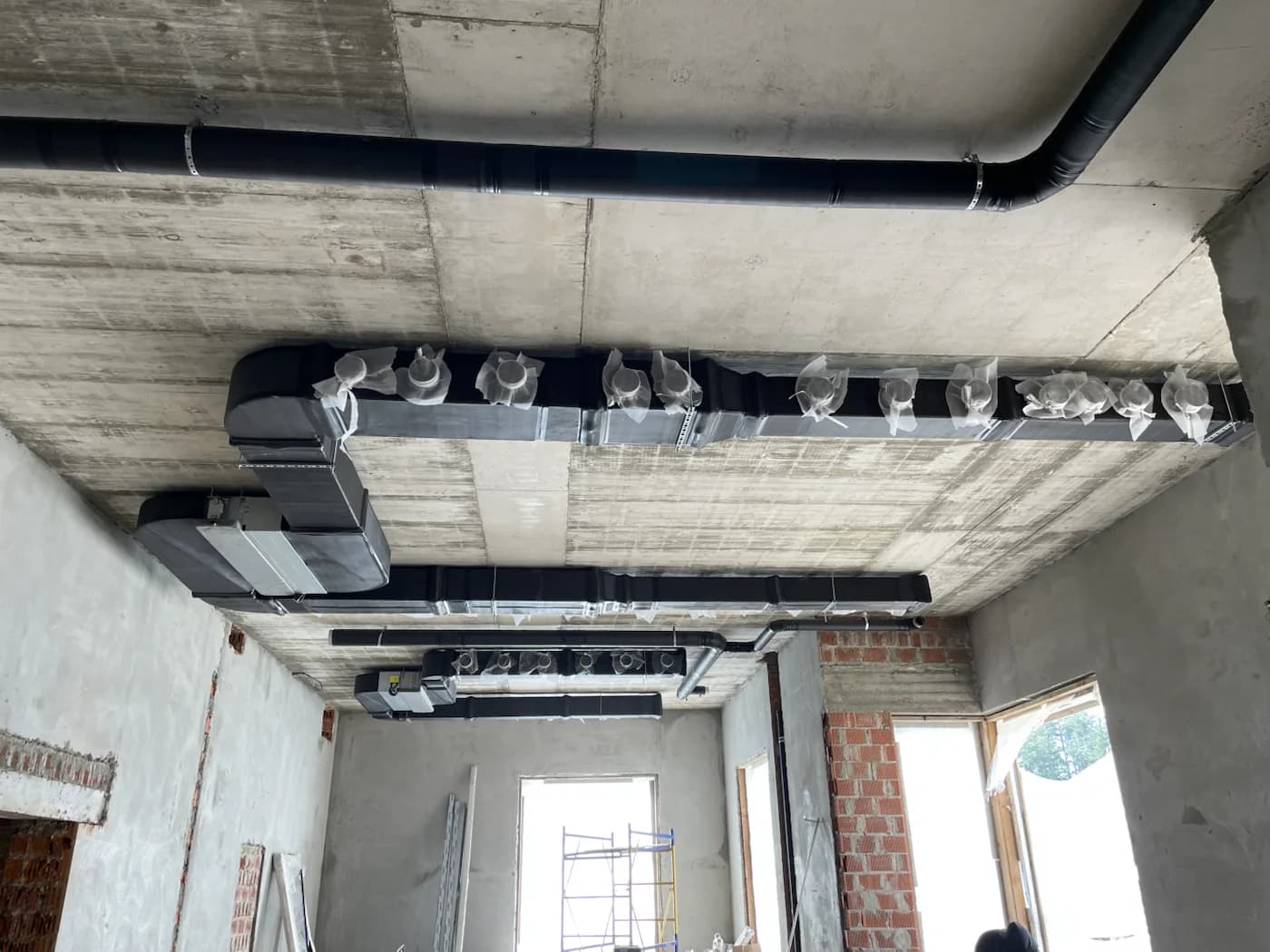
Case 01: rough-in installation of ducted air conditioning and air ducts in a house before finishing.
View residential casesSelection
Ventall does not promote one system type for all houses. The solution depends on the task, budget, layout, aesthetics, facade, noise, and service.
Types
A simpler and cheaper solution for separate rooms. Suitable if the unit does not interfere with the interior, the airflow does not blow onto people, and the facade allows outdoor units to be placed.
Several indoor units connected to one outdoor unit. It makes sense when reducing the number of outdoor units is important, but line lengths, capacity, operating modes, and service must be checked.
A hidden and more comfortable solution for sleep and continuous operation. Requires space above the ceiling, air ducts, drainage, service access panels, and correct noise calculation.
Some rooms may have wall-mounted indoor units, while others may have ducted indoor units. This kind of solution is often more practical than trying to make the entire house one system type.
Used less often and only where it is logical within the overall house system, budget, architecture, and future service.
Ventall can provide wall-mounted indoor units, but does not work in the format of “hang one AC unit in one room” without a design, specification, and engineering task.
Comfort
A wall-mounted air conditioner can be a sufficient and rational solution. It is cheaper, simpler, and faster to implement. But in living rooms it more often creates noticeable airflow, more noise, and a risk of “drafts” near a bed, sofa, or workplace.
Ducted air conditioning works differently: air is distributed through grilles or diffusers, velocities are lower, cooling is more even, and the system itself is less noticeable in the room.
This is especially important for bedrooms, children’s rooms, and rooms where the system works for a long time. But a ducted solution should not be designed without ceiling space, drainage, access panels, noise checks, and service access.
Installation
In a private house, air conditioning affects not only the rooms, but also the facade, roof, technical zones, power supply, and future service. If this is not solved before renovation, the system may be technically correct but inconvenient to operate.
Multi-split or split systems are selected rationally: if separate split systems are cheaper and look acceptable on the facade, this can be a normal solution. If facade aesthetics are important, the number of outdoor units can be reduced through multi-split or a combined scheme.
Ventilation
Air conditioning is responsible for temperature: cooling, partial heating in the shoulder seasons, room-by-room operation, and comfort in hot weather. But a standard air conditioner works with indoor air and does not supply fresh outdoor air into the house.
That is why these tasks are better not mixed in a house: ventilation is responsible for air exchange, moisture, odors, and CO2, while air conditioning is responsible for temperature. If a full microclimate is needed, the systems are designed separately but coordinated by lines, noise, ceiling, automation, and service.
Parameters
For home air conditioning, it is important to look not only at nominal capacity. Heat gains by room, seasonal efficiency, noise from indoor and outdoor units, night operation mode, serviceability, and real installation limitations are required.
Claims about heating, SCOP, low-temperature operation, or refrigerant should not be treated as universal for all models. This is checked using the equipment documentation for the specific model and the usage scenario.
The technical assessment can include DBN V.2.5-67:2013 for air conditioning systems, EN 16798-1 for indoor environmental parameters, EN 14511 and EN 14825 for capacity and seasonal efficiency, EN 12102-1 for equipment noise, and manufacturer documentation.
Next
If you are only choosing the home air conditioning format, it is worth going to the full Ventall guide. It separately shows system types, indoor units, advantages and limitations of split, multi-split, multi-zone, and ducted solutions.
For this page, the air conditioning section is especially important: it helps show why selection starts not with a brand, but with the property, lines, noise, facade, and usage scenarios.
Related
Leave your contact and we will get back to discuss the right solution for your project.