Livestock
In livestock buildings, ventilation must account for moisture, heat, dust, odors, gases, stocking density, seasonal operation, and emergency scenarios. Exact parameters are defined by calculation for the specific facility type.

How to approach ventilation for greenhouses, livestock buildings, warehouses, and product storage zones: humidity, heat, odors, aeration, automation, and engineering calculation.
Agricultural ventilation
One universal ventilation scheme cannot be applied to a greenhouse, poultry house, cattle barn, vegetable storage facility, or cold warehouse. Parameters depend on technology, product, animals, humidity, heat, odors, gases, and the operating conditions of the facility.
Approach
For livestock buildings, heat, moisture, gases, dust, odors, animal type, stocking density, automation, and emergency scenarios are important. For greenhouses, the key factors are crop type, growing technology, air and soil temperature, relative humidity, night condensation, and mechanized ventilation openings.
For product storage or drying, the logic is different: temperature, relative humidity, equilibrium moisture content of the product, risk of re-wetting, condensation, cooling, and aeration. That is why parameters are not set by one universal humidity value or one air exchange rate for all agricultural facilities.
Scenarios
In livestock buildings, ventilation must account for moisture, heat, dust, odors, gases, stocking density, seasonal operation, and emergency scenarios. Exact parameters are defined by calculation for the specific facility type.
The microclimate depends on the crop and growing technology: air and soil temperature, relative humidity, air velocity, excess heat, condensation, and automation.
For warehouses, vegetable storage facilities, cold zones, or rooms with products, temperature, humidity, condensation risk, cooling, aeration, and stable storage conditions are important. Ventilation often works together with cooling, dehumidification, or automation.
Standards and checks
During design, the general requirements for heating, ventilation, and air conditioning are checked, including DBN V.2.5-67:2013, as well as specialized standards for the specific facility type. DBN V.2.2-1:2024 is relevant for livestock buildings, and DBN V.2.2-2:2024 for greenhouses and hotbeds.
For poultry farming, some requirements can be much more specific: for example, Directive 2007/43/EC for broilers shows that parameters depend on animal species and housing system.
For product storage, temperature, relative humidity, aeration, condensation risk, and re-wetting risk are additionally important. FAO materials on grain storage and aeration can be used as an engineering framework, but aeration cannot automatically be treated as drying.
Examples
TASbio shows a task with similar engineering logic: food production, dehumidification, ventilation, and air conditioning for production zones. It is not an example of farm or greenhouse ventilation, but it clearly shows work with humidity and a process environment.
For requests about storage, cold rooms, humidity control, product cooling, or process zones, Ventall can offer closer implemented scenarios.
Fabrication preparation of air ducts, non-standard assemblies, and component sets may be relevant for warehouses, cold zones, and process rooms. Specific m³/h, kW, and technical parameters must be confirmed by a separate implemented facility.
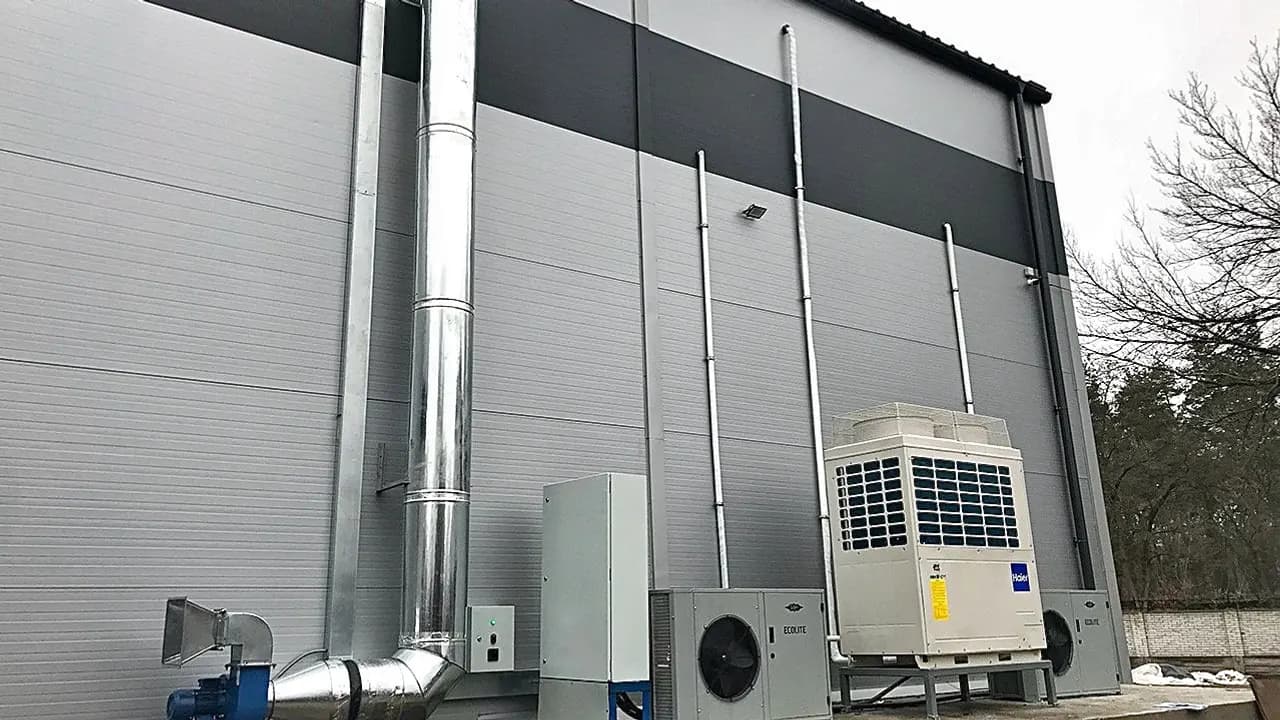
Related example: a veterinary medicine warehouse with stable climate, redundancy, and alarm systems. Livestock buildings require a separate project and specialized standards.
View warehouse projectNext
If the request is about humidity, condensation, drying, or product storage, the logical next step is the humidity or cooling page. If the request is about process rooms, dust, odors, heat, or a production process, the relevant next step is industrial ventilation.
If animals, crop cultivation, ammonia, odors, dust, or automatic control are involved, a separate engineering calculation and specialized standards are required for the specific facility type.
Related
Leave your contact and we will get back to discuss the right solution for your project.