Supply air to living rooms
Fresh air is supplied to bedrooms, children’s rooms, the study, and the living room with the number of people, layout, and required airflow rates taken into account.

Design-based ventilation for a private house before finishing works: central supply and exhaust ventilation system with heat recovery, ducts, exhaust solutions, noise, balancing, and service.
Guide
This material explains full design-based ventilation for a house, not local ventilators: a central supply and exhaust ventilation system, heat recovery, dedicated exhaust solutions, ducts, noise, and checking after installation.
When
This system is mainly relevant for owners of private houses at the construction or early design stage. Usually the building shell already exists, but the ventilation has not yet been designed.
This is the right moment to make the decision: space can be planned for the unit, main air ducts, branches to rooms, sound attenuators, access panels, filters, and service access. After finishing works, ducted ventilation almost always becomes a compromise.
Ventall does not build this page around “ventilators” or local heat recovery units. For a residential house, the basic solution is a central supply and exhaust ventilation system designed for the layout and actual living scenarios.
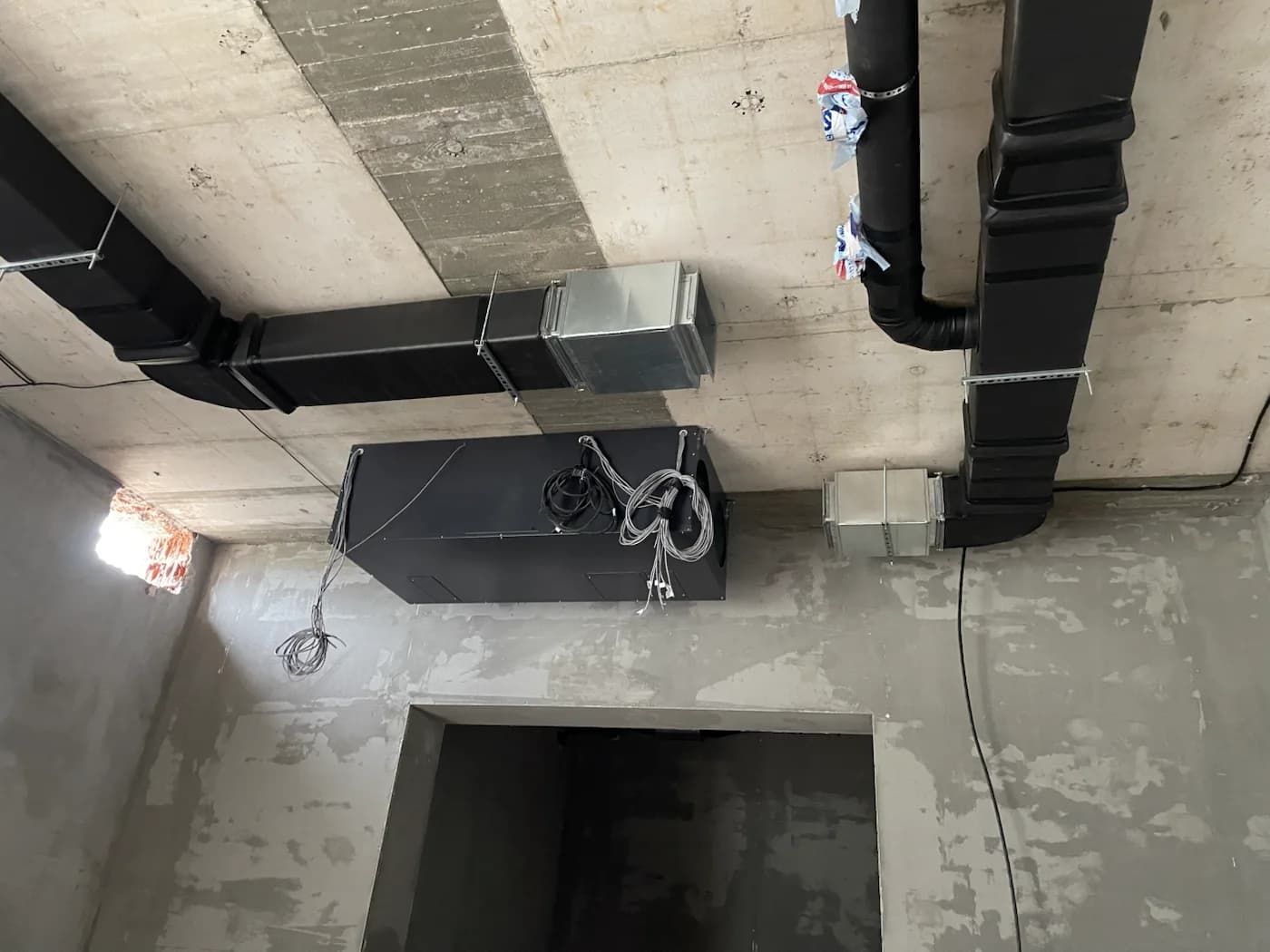
Case 01: ventilation unit and main air ducts at the rough-in installation stage before finishing.
View residential casesLogic
In a private house, ventilation should not just “extract air”, but supply fresh air to living rooms in an organized way and remove stale air from wet and technical zones.
Fresh air is supplied to bedrooms, children’s rooms, the study, and the living room with the number of people, layout, and required airflow rates taken into account.
Stale air is removed from bathrooms, kitchen zones, wardrobes, and technical rooms so that odors and moisture do not spread through the house.
Supply air, exhaust air, and air transfer between rooms are calculated together. Otherwise, the system may be noisy, create drafts, or work differently than intended.
Heat recovery
For a house, central supply and exhaust ventilation with heat recovery is most often considered. It supplies fresh air, removes stale air, and helps return part of the heat from the exhaust air stream.
But a heat recovery unit does not solve the ventilation task by itself. Capacity, aerodynamics, filters, drainage, sound attenuators, automation, installation location, and service access are important.
We do not present heat recovery as a universal promise of savings. Its effect depends on the specific unit, operating conditions, temperatures, installation, and whether the system is properly balanced.
Calculation
Exhaust
In a house, a central supply and exhaust ventilation system does not always cover all local tasks. Separate exhaust solutions can be designed for kitchen zones, bathrooms, and technical rooms.
For example, roof fans are used for kitchen zones, and inline duct fans are used for bathrooms or auxiliary rooms. This is not a replacement for central ventilation of living rooms, but part of a correct air exchange scheme.
Require separate attention to odors, moisture, the exhaust duct route, backdraft, and the air discharge location.
For wet zones, stable exhaust air, backdraft dampers, noise, and correct air transfer from living rooms are important.
Wardrobes, storage rooms, and technical zones are checked separately so that stagnant air or noise near bedrooms is not created.
Quality
In a residential house, ventilation is often meant to be “hidden”. This is normal, but concealed installation should not compromise air quality, noise performance, system efficiency, or service access.
Design trade-offs are better solved at the construction or renovation stage: then ceilings, grilles, diffusers, access panels, routing, and equipment space can be coordinated without compromising technical quality.
Standards
For home ventilation, what matters is not advertising promises, but calculation of air exchange, noise, aerodynamics, equipment access, and verifying operation after installation.
The design assessment considers DBN V.2.5-67:2013 for heating, ventilation, and air conditioning systems, DBN V.2.2-15:2019 for residential buildings, EN 15665 for residential ventilation, and EN 16798-1 for indoor environmental parameters.
After installation, airflow rate measurements, balancing, and system setup in line with EN 12599 / DSTU EN 12599:2025 are important, and noise should be checked against equipment documentation and requirements for residential rooms.
Next
If you are only forming an approach to home ventilation, it is worth going to the full Ventall guide. It shows ventilation types, the difference between supply, exhaust, and supply-and-exhaust systems, the role of heat recovery, design, installation, and service.
For this page, the ventilation section is especially important: it helps show which components the system consists of and why the solution starts with design, not with buying a separate device.
Related
Leave your contact and we will get back to discuss the right solution for your project.