More compact for housing
Cooling through shared air ducts requires larger air volumes. This increases duct cross-sections, the amount of metal, and takes up space that can be used more rationally in a residential house.

A guide for a homeowner: from the first question about ventilation and air conditioning to understanding which indoor climate solution is really worth building.
Guide
This page gives context specifically for a house and leads to the full guide: system selection, budget, design, installation, and service.
Logic
Ventilation is responsible for fresh air, removing stale air, moisture, odors, and excess CO2. Air conditioning is responsible for temperature: cooling, heating in the shoulder seasons, zone-based operation, and comfort in hot weather.
In a private house, these functions should be planned together: where the ventilation unit will be located, where the air ducts will run, where outdoor units will be placed, how refrigerant lines and drainage will be routed, how the system will work at night, and how it will be serviced later.
Checks
The right choice starts not with the equipment brand, but with the house parameters, usage scenarios, and installation constraints.
Configuration
When area, layout, zones, lines, drainage, noise, and service access are clear, the configuration can be selected. For a private house, this is not always one combined system.
After this kind of check, it often becomes clear that it is more practical for a house to have separate ventilation and separate air conditioning, but design them together so that lines, noise, drainage, automation, and service do not interfere with each other.
Cooling through shared air ducts requires larger air volumes. This increases duct cross-sections, the amount of metal, and takes up space that can be used more rationally in a residential house.
Standard air conditioners or multi-split solutions are easier to adapt to bedrooms, the living room, the study, and different usage modes than one custom air system for the entire house.
A custom combined system often brings custom components, VAV dampers, more complex automation, and more expensive consumables. For residential projects, this does not always provide value proportional to the budget.
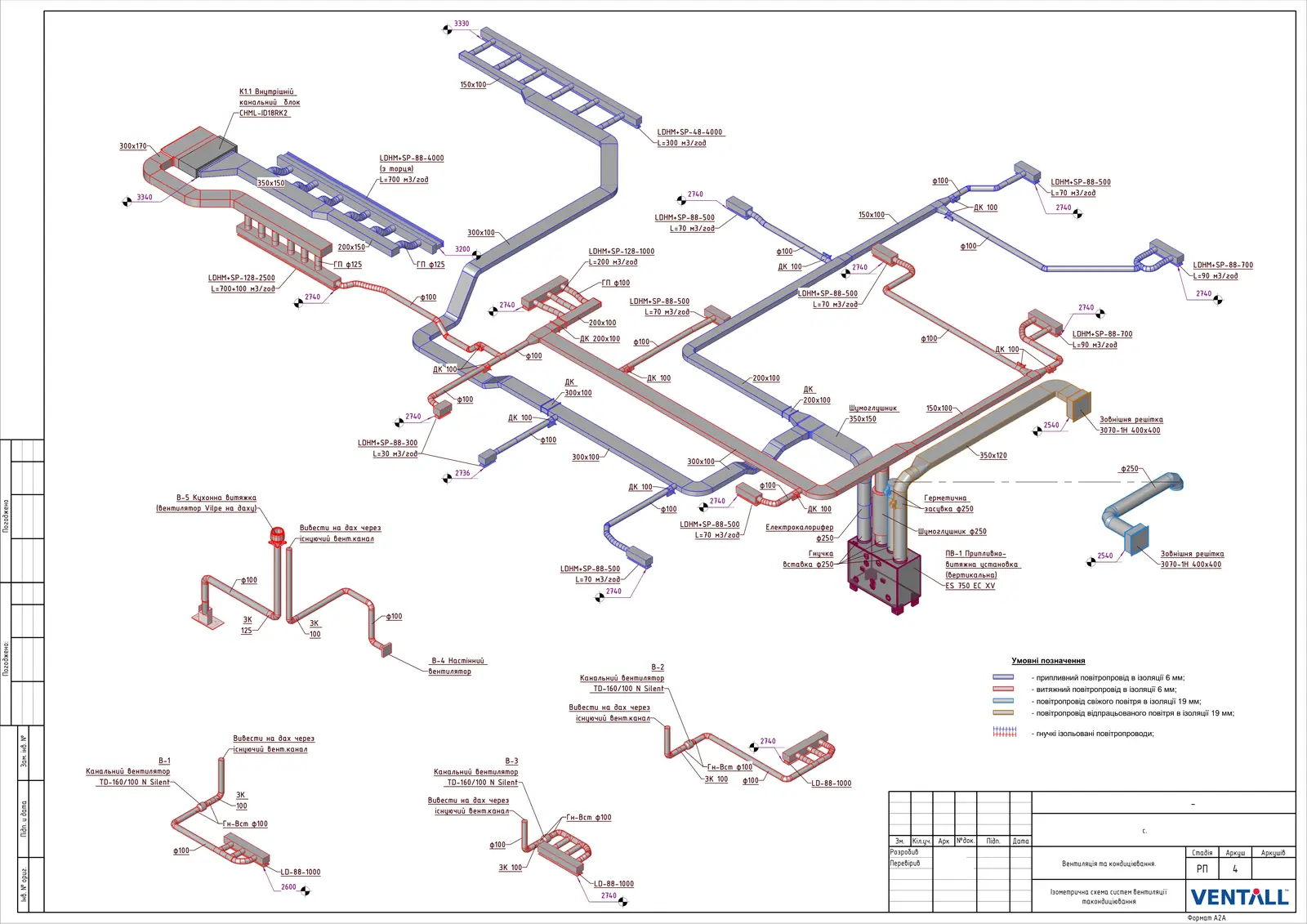
Fragment of a Ventall HVAC project example: air duct isometry and system coordination.
View project exampleStandards
For a house, what matters is not only the feeling of comfort, but also the calculation of air exchange, heat loads, noise, and actual checking of operation after installation. The system should not be selected “by eye” or only by equipment name.
The design logic considers DBN V.2.5-67:2013 for heating, ventilation, and air conditioning, DBN V.2.2-15:2019 for residential buildings, EN 15665 and EN 16798-1 for residential ventilation and indoor environmental parameters.
Noise should be checked against documented equipment dB(A) and permitted levels for residential rooms according to MOH No. 463. After installation, not only startup is important, but also airflow rate measurements, balancing, and checking system operation according to the logic of EN 12599 / DSTU EN 12599:2025.
Ventall approach
In a residential house, the most complex scheme does not always win. A practical solution should be sufficient in capacity, understandable in control, accessible for service, and not take up unnecessary space where this can be avoided.
That is why Ventall first looks at the property, layout, number of people, usage scenarios, budget, and service. After that, it is defined where ventilation is needed, where air conditioning is needed, and where these systems should be coordinated in one design without unnecessary custom complexity.
Next
If you are only choosing an approach to the indoor climate in a house, it is worth going through the full Ventall guide. It explains ventilation types, air conditioning types, pros and cons of solutions, estimates, design, installation, and service.
For the residential scenario, the block about installing separate ventilation and air conditioning systems is especially useful: it shows why for a house it is often better to have not a single custom system, but two coordinated functions within one solution.
Related
Leave your contact and we will get back to discuss the right solution for your project.