Supply air
Fresh air is supplied to living rooms with filtration, noise, air velocity, and the placement of grilles or diffusers taken into account.

How to plan apartment ventilation before finishing works: supply air, exhaust air, heat recovery, filtration, shafts, noise, service, and air quality control.
Guide
This page explains how to organize supply air, exhaust air, filtration, heat recovery, and service in an apartment, and then leads to the full Ventall guide.
Renovation
Ventall works with apartment ventilation at the renovation stage or before finishing works. That is when the unit, air ducts, sound attenuators, filters, grilles, automation, and service access panels can be properly placed.
After renovation is complete, a full ventilation system almost always becomes a compromise: there is not enough space above the ceiling, routing becomes more difficult, it is hard to leave access to filters, and the interior can be affected.
Local ventilators, valves, or wall-mounted heat recovery units are a different type of product. Ventall specializes in full engineering systems, not partial solutions after renovation.
Air
People usually look for ventilation not only because of odors, moisture, or window condensation. The main motive is quality of life: fresh air in the bedroom, better sleep, better daytime concentration, and family comfort without constantly opening windows.
Odors, CO2, humidity, and condensation are symptoms that air exchange is not organized or works inconsistently. A properly designed system maintains continuous air replacement and, if needed, can work with CO2 sensors, automation, and humidification.
In winter, humidity can be a separate task. Ventilation renews the air, but if stable humidity control is required, it is solved with a separate humidification unit, not random household humidifiers.
System
For apartments in Ukraine, supply and exhaust ventilation with heat recovery is most often considered. But heat recovery itself is not the goal: airflow balance, filtration, noise, automation, and service are important.
Fresh air is supplied to living rooms with filtration, noise, air velocity, and the placement of grilles or diffusers taken into account.
Stale air is removed from bathrooms, wardrobes, technical zones, and rooms with odors or moisture.
If needed, CO2 sensors, automation, control by operating mode, F7 filtration or carbon filter, and humidification are added.
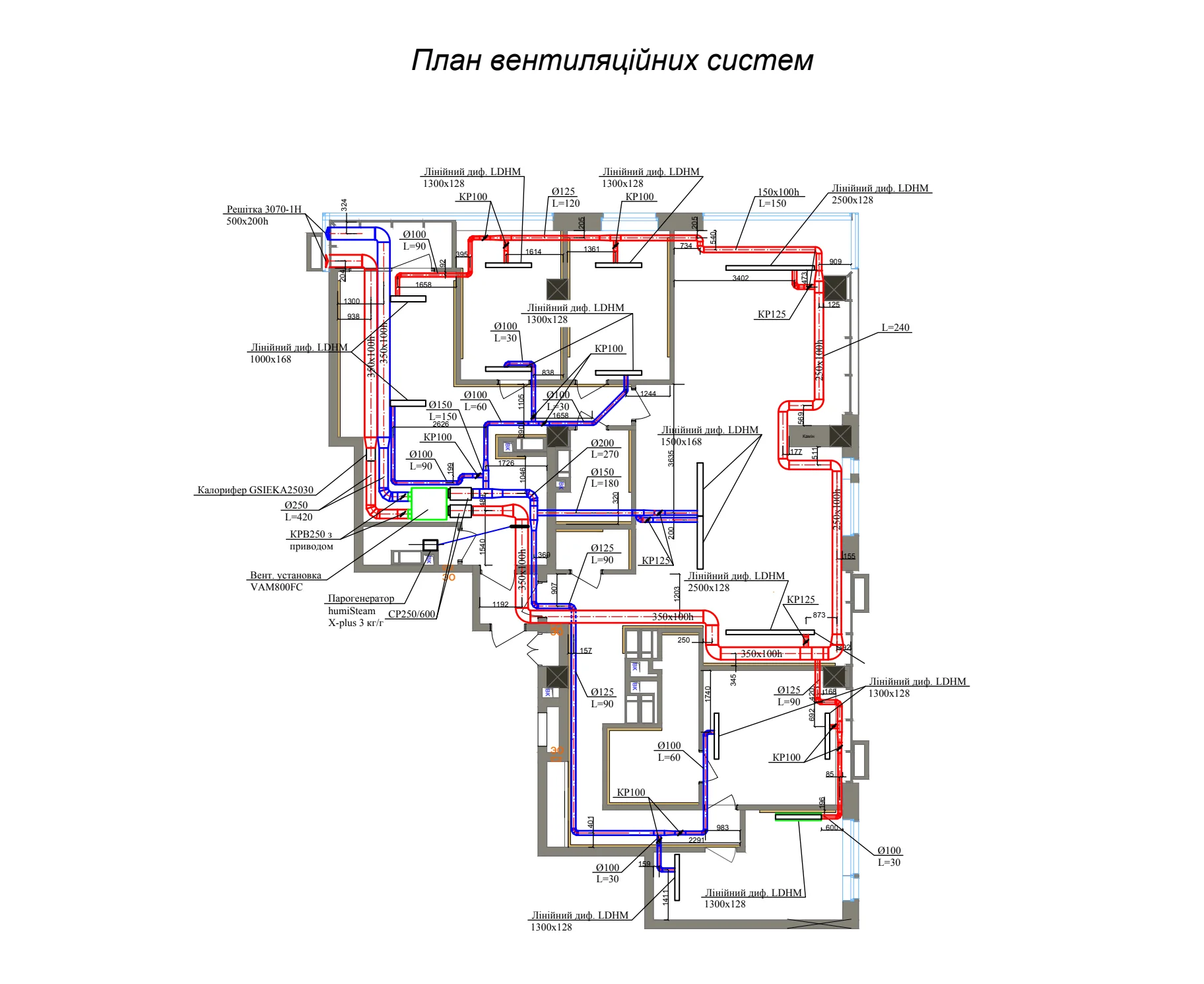
Fragment of apartment design documentation: supply and exhaust ventilation routes, supply and exhaust points are planned before finishing works.
Shafts
In an apartment, existing ventilation shafts cannot be ignored. They need to be checked to understand airflow draft conditions, possible reverse airflow, neighbors’ kitchen hood connections, and the rules of the specific building.
Odors from neighbors often appear because powerful kitchen hoods are connected incorrectly to shared shafts or because the pressure balance is disturbed. In the design, this is addressed with exhaust fans, backdraft dampers, balancing, and continuous air renewal.
A correctly implemented system can effectively prevent outside odors from entering the apartment, but this should not be presented as an aggressive promise to “remove all odors forever”. The result depends on the condition of the shafts, connections, and correct setup.
Checks
Standards
Apartment ventilation should be calculated by air exchange, occupancy scenarios, noise, and service access. A heat recovery unit or ventilation unit by itself does not guarantee the result if airflow rates, aerodynamics, filters, and balance are not calculated.
The technical assessment can include DBN V.2.5-67:2013 for ventilation systems, DBN V.2.2-15:2019 for residential buildings, EN 15665 for residential ventilation, EN 16798-1 / ISO 17772-1 for indoor environmental parameters, and EN 12599 / DSTU EN 12599:2025 for checking and balancing after installation.
CO2 can be used as a practical indicator of insufficient air exchange, but not as one “magic number”. Noise should be assessed through equipment documentation dB(A), equipment location, sound attenuators, and the actual night mode.
Next
If you are only figuring out what type of ventilation an apartment needs, it is worth going to the full Ventall guide. It explains supply, exhaust, and supply-and-exhaust systems, heat recovery, design, installation, and service.
For this page, the ventilation section is especially important: it helps show the difference between natural, mechanical, supply, exhaust, and supply-and-exhaust systems without tying everything to one “magic” piece of equipment.
Related
Leave your contact and we will get back to discuss the right solution for your project.